
Many organizations, even sophisticated ones, build relationships with service providers over years without any real framework for managing them: no tickler file to remind the business when the contract comes due (or where the executed version is), no record of what either side promised, no idea if the product is delivering (or even still being used). Is the vendor charging a fair rate? Are there excess licenses? No idea.
Multiply that by 10, 20, or 2,000 different contracts, and the wasted dollars are significant. But so is the uphill climb to get it all under control.
That’s why effective vendor management starts by gaining visibility into what you use, how you use it, and how much you’re paying—and by connecting these insights to your business goals and bottom line.
The Cost of Falling Behind: Why Preparation = Power in the Vendor Management Process
Vendor chaos is a common and expensive problem. So, how do so many companies end up there?
Simply put, they lack strategic discipline around vendor data and contract management, and that’s because these agreements are usually signed out of an immediate need: your business is growing, you need more licenses or a more powerful tool. There’s no time to waste, so you enter into a negotiation without the necessary visibility and preparation.
But here’s the catch: Vendors—especially those whose lifeblood is sales—get organized. They stay 18-24 months ahead. They understand the nuances of the company they’re working with: their budgeting cycles, renewal timelines, who in your company supports them, and who doesn’t. They’ve got a sales framework—and that gives them a great amount of leverage.
If you’re not more prepared than they are (or at least as prepared), you’re in a weak position. You’re likely to accept the offer they’re giving, maybe resist a little, but ultimately not represent what your business actually needs.
With timing, insight, and preparation, you can flip the power dynamic in contract negotiations and make more informed decisions that directly impact your spend management strategy.
Preparation is the core of solid vendor relationship management, but it’s easier said than done when you’re working through hundreds (or thousands!) of providers. You can’t expect to undo the chaos all at once. It starts by measuring your priorities and working from there.
Step 1: Take Inventory and Prioritize
You can’t manage what you can’t see, but you don’t have to do everything at once.
Start with a snapshot of where everything is—what the terms are, when they terminate, what promises were made—and put it all into a structure. Once you’ve done that, you can prioritize: What are the bigger negotiations coming up in the next one to three months?
You may not be able to fix every contract immediately, but you can focus on the biggest ones first, get some quick cost savings, and then repeat with the next tier. This builds visibility into your vendor lifecycle and aligns your business process around high-impact contracts first.
Step 2: Reframe the Relationship
Think of vendor management in terms of strategic alignment, not firefighting or trimming fat. That means understanding timing, leverage, and what truly matters to your organization.
Vendors have different strategic clocks. With your snapshot at hand, you have one too: It’ll show you which contracts are at risk of auto-renewal and which haven’t been reviewed in years.
Know the vendors’ timeline — but also, know yours. Most leverage comes from being ready before they are. If you put together a system, you go from a frantic environment of “Oh no, I have to talk to these guys this afternoon” to a deliberate decision-making process that supports your business objectives.
How much better does this sound? “We’re going to renegotiate this contract in the next 12 months. Let’s start talking to our end users. Let’s do some research into what our peers are doing. Let’s figure out who the other players are and if this is even the right service provider for us. Let’s look at our use of the product to see if we could downgrade our service or reduce our support licenses and still meet our business needs.”
The other part of the puzzle is knowing what truly matters to your organization in this partnership. Then you can concede contract terms that don’t matter to you and quietly win on the things that do. You can negotiate for lower rates, improved terms, and better service guarantees if you understand what’s important to your bottom line.
Step 3: Optimize Negotiations with Data and Intelligence
While the focus of your negotiation is your organization’s needs, don’t overlook the bigger picture: What is commonly made available by this vendor to other companies? What are they charging?
Large companies that have not gotten organized will often find out that they’re paying more than smaller ones—and that they have terms that aren’t as good as their industry peers.
Benchmarking, peer intelligence, and structured comparisons lead to smarter, data-driven decision making. There are organizations that talk to hundreds of companies to triangulate what vendors really charge, how they structure deals, and what terms are common.
With one client, we found out we were one of the largest consumers of a certain software and one of the earliest adopters—yet we were paying 15% more than anyone else. When you do your due diligence with vendor comparison grids, market benchmarks, and competitive intelligence, you end up with fair market pricing and measurable performance metrics.
Step 4: Build a System So It Doesn’t Break Again
Early-stage vendor management may feel a little like building the plane while flying it, but if you create a system at the same time, you’ll ensure you’ve got a well-oiled (AI-powered) assembly line heading into the future.
Start committing contracts to a system that does the work for you—reminders, renewals, and performance monitoring. Today, AI and automation can streamline your workflow significantly by eliminating manual processes: it can help extract terms, capture dates, send quick surveys, and track trouble tickets in real time. It won’t do it magically, but it can take a lot of the heavy lifting out of managing the vendor data.
Once you’ve centralized the data, the next step is governance—deciding who owns vendor relationships and how informed decisions get made. Without clear decision rights, even the best systems erode over time. Define:
- Procurement decision rights: Who can add or renew a vendor contract? Who must approve spend thresholds?
- Performance feedback loops: After each quarter, collect structured input from stakeholders using or managing the vendor. This not only improves accountability, it also builds a performance history that strengthens your negotiating position.
- Renewal discipline: Schedule reviews 90-120 days before renewal dates to allow time for data gathering, peer benchmarking, and stakeholder alignment.
- Continuous improvement: Use the insights you collect to refine your vendor criteria—price, performance, flexibility, and cultural fit—so the process gets sharper over time.
A Strong Vendor Management Solution Aligns Spend with Strategy
In business, two things seem inevitable: taxes and vendor price increases. But it doesn’t have to be that way. Implementing a vendor management system can yield a 20% cost savings, but beyond a one-time benefit, I’ve seen the savings continue year after year—despite 10–15% annual price increases.
Beyond savings, professionalizing vendor selection and management creates a proactive, data-driven function—not a crisis-response team. You can start small: quick questionnaires, calls to department heads, or basic benchmarking can evolve into a structured system of metrics and KPIs.
Vendor management isn’t just about cutting costs—it’s about building clarity, leverage, and control into how your business operates. That’s how every negotiation becomes an opportunity to align spend with business strategy.
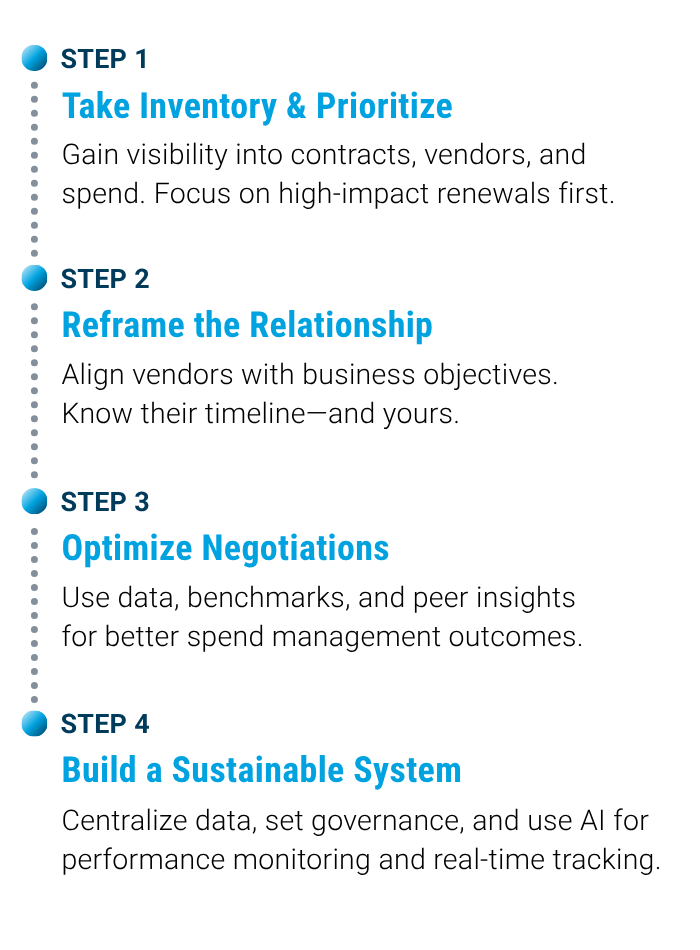
The Vendor Clarity Framework: 4 Steps to Smarter Spend
To discover other ways your business can cut costs and make data-driven decisions, reach out to our business transformation team.