
Most businesses need a specific level of qualified pipeline to hit their revenue goals. The question is: how much pipeline do you actually need?
The answer comes down to a simple formula built on a few key inputs — your close rate, sales cycle, contract length, and revenue capacity. When you calculate your ideal pipeline size correctly, you can move from guessing at future growth to forecasting it with confidence.
When you first started your business, you were likely focused on just getting as many clients as possible. In the beginning stages, you are just trying to establish yourself and grow a consistent client base. However, as your business expands, you might become aware of a sweet spot: a specific number of clients necessary to cover costs while also putting away enough money to reach business goals. In fact, a frequent question we get from clients is “What is my ideal pipeline size?” This becomes especially important when you’re trying to forecast revenue, since pipeline is one of the most controllable inputs into future cash flow.
The reality is that the ideal pipeline size for your business will depend on your business goals. While that seems abstract, it becomes much clearer when you understand how much work your team can actually take on based on its production capacity. From there, we can build a formula that gives you a very specific, concrete answer.
Calculating Your Ideal Pipeline Size
Here’s a simplified formula that shows how sales cycle, contract length, and close rate work together to determine ideal pipeline size:
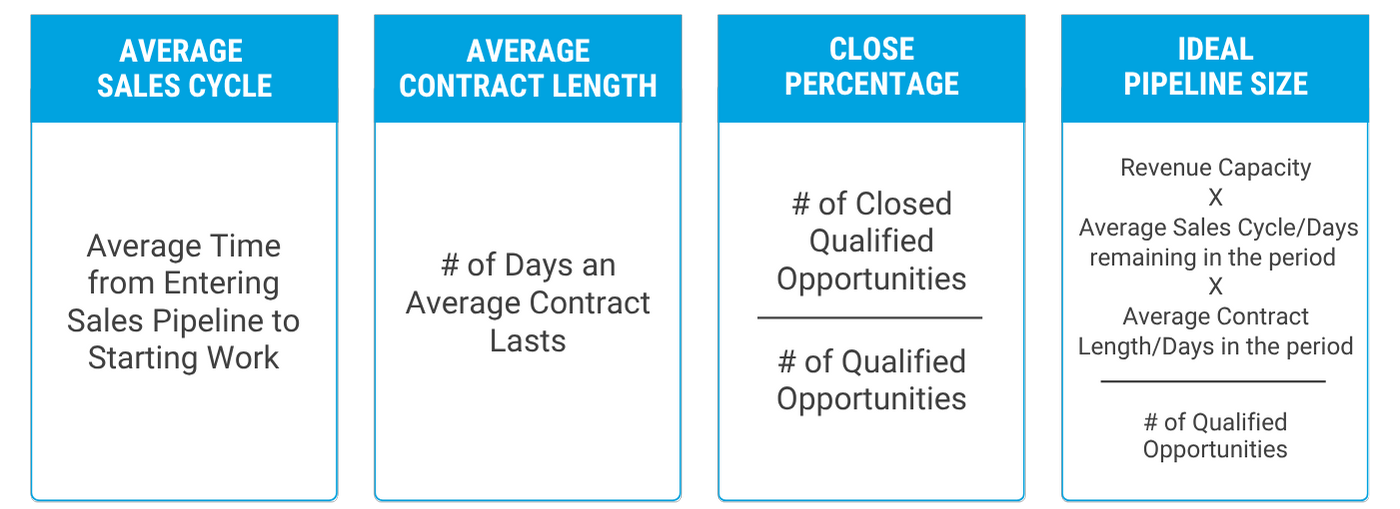
To begin calculating your ideal pipeline size, you first need to know your average sales cycle. The average sales cycle is the time it takes a deal to enter your sales funnel to the point at which work begins. If you haven’t begun tracking this metric, it’s an important first step in making plans for business growth. Many of our clients use HubSpot or Pipedrive, but there are many CRM systems that can track this metric.
Next, you will need to calculate average contract length. This is the number of days that your client contracts last. This metric is important because it helps you understand how quickly revenue turns over in a given period.
After you’ve calculated your average contract length, you will need to determine the close percentage. There are two pieces of information required to calculate the close percentage: the number of closed qualified opportunities and the number of qualified opportunities. Divide the first number by the second.
The final step is to calculate your actual ideal pipeline size using the other metrics you collected. Take:
Revenue capacity × (average sales cycle / days remaining in the period) × (average contract length / days in the period)
Then divide this number by the number of qualified opportunities.
This gives you your current ideal pipeline size. If you want to calculate pipeline size based on a future revenue goal, place that goal in the revenue capacity slot and adjust the days in the period to match your timeline.
Planning Your Business Goals
Making a plan to grow your business involves setting KPIs to measure progress. Ideal pipeline size is one of the most important metrics to monitor and adjust over time. Scenario planning with a solid dynamic forecast is one of the most effective ways to translate your pipeline into actionable growth targets, while tracking the right metrics helps you stay on course as conditions change.
If you need help translating your pipeline into realistic growth targets and aligning it with your team’s capacity, connect with a Virtual CFO advisor to build a plan that supports sustainable growth.