Mirren Live 2026 (presented by Mirren) brought together creative agency leaders who are actively reshaping how the industry works. It’s where the real conversations happen about what’s working, what’s broken, and what comes next. This year covered a lot of ground across AI, operations, finance, and creativity.
Below are recaps from three sessions I attended. One was a reminder of what original creative work takes, one pulls apart what a modern agency model can look like, and one gets into the operational unglamour of making it all sustainable.
The Creative Collision of Art, Imagination & Tech
with Damian Kulash, Lead Singer & Guitarist, OK Go moderated by Brent Hodges, Mirren CEO
Not every session starts with a music video shot in a Budapest train station using four industrial robots powerful enough to lift a house. But this one did.
Damian Kulash, frontman and one of the creative forces behind Grammy-winning band OK Go, joined Mirren CEO Brent Hodges for what turned out to be one of the more disarming conversations of the week. No slides. No frameworks. Just an honest, sometimes funny, always thoughtful look at what it means to make something original … and what gets in the way.
Constraints Aren’t the Enemy
If you walked in expecting a pep talk about “how technology can unlock creativity,” Damian reframed that pretty quickly. His analogy: there’s one aerodynamically perfect shape for a car. The closer you get to it, the less room there is for anything interesting. Optimize everything and everything starts to look the same. The same logic applies to creative work.
The danger of maximum efficiency isn’t just creative sameness. It’s that everyone arrives at the same answer. And if everyone’s using the same tools to solve the same problems, the output starts to look identical.
Play Before You Plan
OK Go’s process, Damian explained, is essentially play. Before shooting their “Upside Down and Inside Out” video filmed inside a Russian zero-gravity aircraft, they dedicated six full flights just to experimentation. No shot list. No deliverable. Just a group of people floating around the cabin, bouncing off the walls, releasing different liquids and objects during each weightless window to see how they’d move, how they’d look, and what they’d feel like on camera. All of it pure play, with no predetermined outcome. Just figuring out what was possible before deciding what to make.
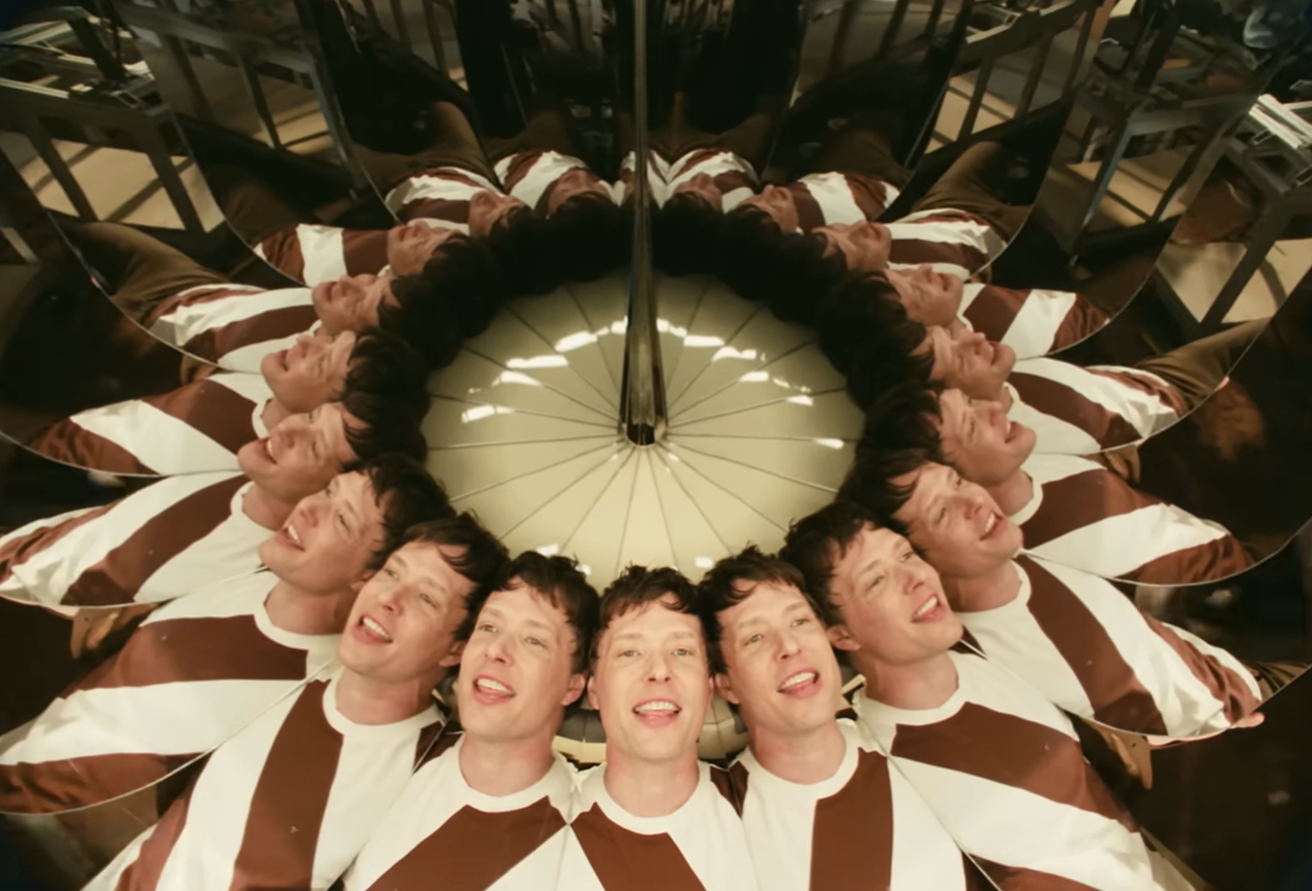
The video for “Love” worked the same way. A week of two people in an office with a stack of mirrors and a song playing … just moving them around, sticking their heads in, watching the reflections multiply, discovering what was possible. That’s how you find it: the moment where pulling back the camera reveals that an entire infinite kaleidoscope world is just two guys holding two flat mirrors. That reveal hits hardest.
For agencies, that’s a harder sell. Play requires time, budget, and a client (or leadership) willing to trust what comes out the other side. But Damian made a compelling case that it’s one of the only moves left that 15-year-olds on TikTok can’t replicate for free.
If you stopped by the Anders booth, you may have grabbed one of our light-up bouncy balls. We thought creative agencies might put them to good use. We feel a little play goes a long way in a brainstorm. This session was a good reminder of that.
The Takeaway for Agencies
Damian wasn’t prescriptive about how agencies should work. But between the stories of OK Go’s creative process, a clear argument emerged: the one thing that can’t be commoditized or scaled by AI is genuine discovery. The thing you find when you give a team real space to play, real permission to be wrong, and real stakes in getting it right.
New Agency Models: Built to Be More Efficient, Profitable & Future-Proof
with Alexandra McInnis, President & Co-Founder, Murder Hornet | Stephanie Wiseman, CEO, 10kR | Dave Porter, Global Director of Technology Integration & Innovation, OLIVER Agency moderated by Frankie Rodriguez, Partner & CEO, Anomaly
Frankie Rodriguez set the tone before anyone spoke: the traditional agency model didn’t break overnight. It optimized itself into irrelevance. Overhead became the business model. Headcount became the measure of what you could do. And somewhere along the way, the structure stopped serving the work and started serving itself.
Three panelists with three very different responses shared their approach to that problem.
Murder Hornet: The Nest & Swarm Model | Alexandra McInnis, President & Co-Founder
Murder Hornet was built as a direct response to an industry in flux. The layoffs, the mergers, the freelancer renaissance, the burnout … all of it signaled that something needed to change. Their answer was structural: a tight permanent core team (the Nest) surrounded by an on-demand network of over 1,000 vetted freelancers (the Swarm).
- The Nest is 10% of the team: client-facing, relationship-building, operationally focused
- The Swarm is 90% of the team: all 1099s, all vetted, assembled per project and brief
- AI now orchestrates the search and assembly process, targeting 80% efficiency gains in swarm coordination
- Operating expenses were down 5.5% in 2025, with another 22.5% reduction projected for 2026
The model gives clients flexibility that a traditional staffed agency can’t match. If a brand refresh pivots to a packaging redesign mid-engagement, Murder Hornet can rebuild the team around the new brief without the drag of a fixed headcount. It also lets them access senior creative talent without carrying that cost all year.
Alex’s biggest operational lesson: understand your agency process soup to nuts before you try to fix it. Before rethinking your model, introducing new pricing, or layering in AI, know exactly where your inefficiencies live. Fix process before you rebuild structure.
A few things she flagged as non-negotiable for anyone considering this model:
- A strong creative roster lead who owns freelancer relationships
- Tight onboarding and offboarding: Freelancers need to be set up for success and closed out with care
- Pay freelancers on time and treat them like people: It pays dividends in creative output
- Bring procurement along early: Their bonuses depend on savings, and this model speaks their language
10kR (10,000 Robots): Big Agency Thinking, Without the Bloat | Stephanie Wiseman, CEO
Stephanie started 10kR after a conversation that stuck with her. A brand-side contact mentioned that seven months into an agency engagement, someone on his team built a prototype of the same product over a weekend. That gap between what agencies charge and what’s now possible is exactly where 10KR operates.
The agency sits at the intersection of consultancy, tech company, and creative shop with three core offerings:
- Workflow acceleration: Identifying where AI can create velocity without sacrificing quality
- Building and deploying AI solutions: Digital experiences, products, agents at a fraction of traditional cost and time
- Content systems: Helping clients think in systems rather than individual assets
A standout case study:
For Nissan’s European micro mini launch, 10kR produced over 400 assets with a 60% reduction in cost per asset, going from brief to launch in four weeks. The tool they built, BumperBot, handled it all. Headline options generated, approvals routed, assets dropped into templates, translated across languages, and trafficked out. No manual steps in between.
Which raises a question: if you can build something in a weekend, how do you justify what you charge?
Stephanie’s answer was direct: we’re back in the era of big ideas. The doing is democratized. The thinking isn’t. An AI-built prototype is not a production-ready product for six million customers. The value lives in knowing what to build, how to test it, and how to scale it responsibly.
Her working methodology, which doubles as a philosophy for the whole agency:
- Small pilots over big roadmaps
- Working demos over decks
- Outcomes over hours
OLIVER Agency: AI Built Into the Infrastructure | Dave Porter, Global Director of Technology Integration & Innovation
Oliver is a different scale entirely. 300+ clients, 50+ countries, nearly 30% more cost-efficient than traditional agency models. But the structure is less one big agency and more 300 individual studio units working in unison, embedded directly inside client organizations.
The backbone of Oliver’s AI story is Pencil Pro, a platform developed by parent company Brandtech Group and trained on over a billion dollars in real media spend. Every team and every client get access. And everything that comes out of the platform is graded immediately against performance data, brand guidelines, and industry benchmarks
What makes the Oliver model instructive isn’t just the technology. It’s the discipline of standardization:
- No shadow AI: Every team has a governed sandbox, a safe space to learn, test, and use AI without compliance or IP risk
- Client-specific model configurations: Google clients use Google models, Microsoft clients use Microsoft models
- Billing, booking, and job tracking embedded directly into the AI platform: Efficiency gains are measurable in real time
- Production cycles cut from days to minutes: Overnight asset generation at scale without adding headcount
Dave’s biggest takeaway for the room: they didn’t add AI to their model. They built around it.
Standardizing the toolset across a global network means any work can move to any team anywhere and every upgrade rolls out simultaneously to every client.
What All Three Had in Common
Three different starting points, three different philosophies. But a few threads ran through all of them:
- Fixed costs are the enemy. Whether it’s a bench of full-time talent, a long-term lease, or a rigid rate card, the agencies gaining margin are the ones that have made their cost structure flexible.
- The idea still wins. AI handles more of the doing. The thinking, the strategy, the instinct for what’s worth making. That’s where agencies need to double down.
- Clients are ready for this. Procurement teams respond to cost efficiency. Brand leads respond to speed and outcomes. The pitch isn’t hard. The model just has to actually deliver.
Empowering Agency Teams for Financial Accountability & Growth
with Hannah Hood, Virtual CFO Principal, Anders moderated by Meredith Nydam, Director of Resourcing & Operations, Uncommon Creative Studio
A room full of agency operators from 10 to 120 people, all circling the same problem: profitability is everyone’s job, but somehow it only lives in the C-suite. Here’s what the room kept coming back to.
Transparency Without Education Doesn’t Work
Sharing financials with your team is only useful if they know what they’re looking at. A few things Hannah flagged:
- P&L sharing is generally fine, even encouraged
- Balance sheets are dangerous without real business acumen behind them
- Every number you share needs a “here’s why this matters to you” attached to it
Making It Personal
The incentive structures that resonated most tied individual behavior to agency outcomes in ways people could actually feel:
- Quarterly bonuses keep the feedback loop short enough to matter
- Blinded scenario modeling, “here’s what your bonus would have been if we hadn’t lost that client” made the connection visceral
- Pairing individual performance metrics with agency-level results gave people a sense of control over something, even when the bigger picture is out of their hands
The Timesheet Problem Nobody Has Solved
This took up most of the room’s energy. Without time data, you can’t pinpoint margin loss, scope accurately, or have honest client conversations about overages. Enforcement tactics from the room ranged from creative to chaotic:
- Email jail (locked out of inbox until timesheet is complete)
- Accountability buddies – intentionally mismatched pairs so you don’t want to be the one holding a stranger back
- $1,000 year-end bonus for perfect weekly completion – only two people earned it
- Random $500 Fridays, unannounced, paid to anyone with a completed timesheet that day – this one got the most traction
Hannah’s bottom line: Tie it to performance reviews. It stops being admin and starts being a professional expectation.
AI in the Finance Seat
Early days, but the room is moving:
- Client-specific AI tools trained in reporting preferences cut a three-week task to a few hours
- Several agencies are experimenting with AI for scoping and pricing against historical data. Results are promising but not yet reliable
- The next frontier: real-time financial visibility that doesn’t wait for a monthly close
By the end, the timesheet horror stories had become something more useful: a shared acknowledgment that the unglamorous operational stuff is where agency profitability actually lives or dies.
How Anders Virtual CFO Helps Growing Agencies
The conversations at Mirren Live, around profitability, operating models, and sustainable growth, are ones we have with agency leaders every day. Anders Virtual CFO works with creative agencies to build the financial infrastructure behind that growth: forecasting, cash flow, agency-specific KPIs, and the kind of profit-focused strategy that lets you focus on your clients instead of your books. Learn more about our Virtual CFO services.